Cenobites
The Hellbound HeartThe Cenobites are the Order of the Gash’s otherworldly emissaries, summoned through Lemarchand’s Configuration by seekers who mistake their mastery of sensation for a promise of pleasure. Their encounters turn that expectation inside out: what humans imagine as ecstasy becomes an ordeal the Cenobites call pleasure, and their indifference to mercy makes them more than supernatural guides. They are a force that crosses the boundary between worlds, imposes its own terms, and ultimately claims Frank Cotton again.
Identity and Appearance
The Cenobites come from a realm beyond the door opened by Lemarchand’s Configuration. Kircher had described them to Frank as experts in pleasure, and Frank understood the Order of the Gash through his conversations with Kircher and his study of historical diaries. Yet knowledge of their name and reputation does not prepare him for their arrival. A quartet appears in the room, their presence marked by a cold, faint light and bodies visibly altered by deliberate bodily modification. Their appearance and bearing unsettle Frank, who had imagined powers and pleasures more familiar to human desire.
The group’s number is not fixed at four. Frank objects that Kircher had told him there would be five; the answer is that the Engineer will arrive if the occasion merits it. This exchange establishes the Engineer as a possible additional presence, not an automatic member of every encounter. One of the initial four remains silent and concealed. After Frank’s ordeal, that figure appears unveiled as a woman, revealing that the first encounter had not shown him the entire group.
Summoning and the Promise of Pleasure
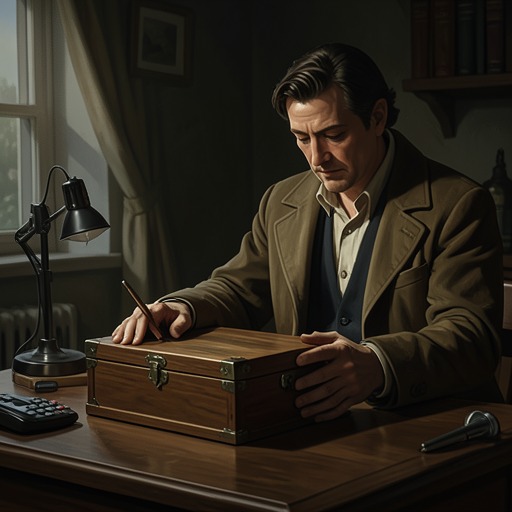
Frank’s encounter begins after he spends hours solving the box. A bell announces that the boundary is opening, and the sound comes through the invisible door the box was made to create. He has prepared the room according to Kircher’s instructions: the floor is cleaned and strewn with flowers, while an altar bears assorted offerings. The careful ritual underscores how much he expects to control the meeting. He has prepared for the Cenobites as though correct observance will secure their favor.
When they arrive, the Cenobites ask what he wants. Frank answers that he wants pleasure, relying on Kircher’s account of their abilities. They recognize the nature of his desire, but make clear that they do not understand pleasure as he does. The difference is not a minor misunderstanding about what kind of experience to provide. Frank has imagined human gratification and believes the Cenobites can deliver it; they regard his desires through a radically different account of sensation. Their knowledge of his expectations makes the mismatch more unsettling, not less: they understand what he wants without accepting that his definition of pleasure governs what follows.
Frank Cotton’s Ordeal and Captivity
The Cenobites expose Frank to an overwhelming intensification of sensation. He experiences ordinary impressions as unbearable and is assailed by a multitude of sounds; the ordeal grows rather than relents when he begs for it to stop. It ends abruptly, leaving him briefly unsure of his own existence. When his senses return, the room is empty of the ritual objects, and the previously silent Cenobite appears in a new form. Her presence combines sensual display with evidence of death, making plain to Frank that the promised pleasure has nothing to do with the human fulfillment he expected.
Frank later understands the encounter as the beginning of a captivity that has lasted weeks and months. The Cenobites have subjected him to suffering that he cannot interpret through any stable system of reward, punishment, or appeal. He cannot tell whether they mean what they call pleasure; their principles remain, to him, irreducibly ambiguous. The Engineer is associated with the design of further suffering, while the Cenobites allow their prisoners brief glimpses of the places where they once worked the Configuration. Frank’s place of confinement looks onto the upper room at 55 Lodovico Street, so the world he has lost remains visible from beyond the boundary that imprisons him.
Return Through the Configuration
The Cenobites’ power becomes relevant again when Kirsty works on the box in hospital. A solemn bell sounds from within the room, the walls seem subtly changed, and the light fails; the Cenobites appear at the end of her bed. Kirsty asks whether they know Frank Cotton, and they confirm that they do. She learns that Frank also solved the box and that he sought pleasure before they gave him their version of it. This exchange links her encounter to his earlier one: the Configuration opens onto the same order, but a new petitioner can negotiate rather than simply repeat Frank’s mistake.
Kirsty bargains for her own survival by offering to deliver Frank alive. The Cenobites make the condition more exact: he must confess himself. Their response is not a promise of uncomplicated rescue; it sets a task and attaches a threat to failure. The exchange makes their dealings transactional and conditional. Kirsty’s knowledge of Frank becomes the means by which she can redirect the Cenobites’ claim toward him.
Reclamation and Narrative Role
At the final confrontation, Kirsty recognizes that the man presenting himself as Rory is Frank wearing his brother’s skin. Once she identifies him, the Cenobites take hold of Frank with hooks and chains, preventing him from reaching her and drawing him back toward the room’s center. Their intervention fulfills the bargain’s central demand: Frank is exposed and returned to the beings who had already claimed him. His attempted disguise cannot erase the identity that Kirsty names or the obligation he owes the Cenobites.
Across these encounters, the Cenobites are defined less by a simple opposition between pleasure and pain than by the collapse of that distinction in their world. For Frank, the decisive error is to assume that their promise answers to human desire; for Kirsty, survival depends on understanding their conditions and using them against Frank. The recurring bell, the opened threshold, and the rooms that connect the ordinary world to confinement make each meeting a passage across a boundary. Yet the passage does not offer freedom on equal terms: the Cenobites set its conditions, and Frank’s return to their custody closes the arc begun when he first summoned them.